A Weekend with Facing History and Ourselves
You know you’ve been to an incredible conference when you leave excited to get home and start working. This feeling I’d imagine is less common in events for consumer goods (Unless of course you have a Dunder Mifflin level passion for paper or something) but being in educational travel, the mission to build international bridges surrounds us every day and drives us forward. So, when you come into contact with other people who are just as passionate, just as ready to see the world change for the better as soon as possible, it feels like lightning up the spine.
It feels like the Facing History & Ourselves Leadership Summit.
In 1976, two years before a company called ACIS got off the ground, Margot Stern Strom established Facing History & Ourselves, a non-profit dedicated to bringing exceptional curriculum on challenging historical topics to classrooms across the United States. Margot was an extraordinary educator with a difficult past: She was a Jewish woman who lost family in the Holocaust. On top of that tremendous emotional burden, she grew up in the Jim Crow South and watched with horror as African Americans were subjected to life as second-class citizens. She decided that talking about these hard topics with students was the way to prevent the horrors from repeating themselves, so she became a history teacher, eventually founding Facing History and Ourselves to expand the work beyond her own classroom. Her legacy is carried on today by an inspiring mix of educators, former educators, classroom consultants and civic leaders who share Margot’s belief that we have to name our history and reckon with it, in order to heal the world’s fractures.
Over two days at the leadership summit in Atlanta, Martin Luther King’s home city, we asked ourselves how we can live up to this promise today.
Sessions ranged from the history of Atlanta as a hub for Civil Rights activism to challenges in contemporary antisemitism education. We asked ourselves questions that were uncomfortable but necessary: How does history inform the current polarized political landscape we live in? Where can we make room for new viewpoints while still shutting out bigotry?
By far the most meaningful session I attended was a conversation with Dr. Terrance Roberts, one of the Little Rock Nine who integrated Central High School in 1956.
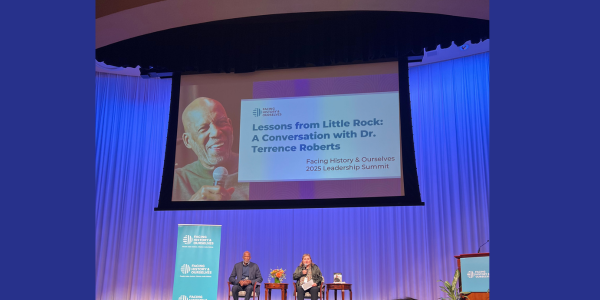
With a speaking voice that settles you the instant you hear it, Dr. Roberts spoke about the terror he endured at just 15 years old. Like so many other Black American children, he was forced to grow up too quickly in a hateful landscape, but it never crushed him, and the courage he showed at that young age was nothing short of remarkable.
He is the student we want to encourage through the educational experience, someone who will stand up even on shaking knees to do what is right. The network of educators using Facing History & Ourselves resources are who we want to support through our travel programs, the teachers and leaders who encourage students like Dr. Roberts.
With so many core values in common, bringing our two organizations together feels like kismet. In 2026, ACIS will be partnering with Facing History and Ourselves on a trip to Morocco to explore Jewish identity during World War II, but this is just the start of our collaboration. Someday, ACIS could offer Facing History curriculum materials to traveling teachers, and Facing History could share our educational travel opportunities to classrooms across the United States. Facing History can, through its programming, ask the tough questions we were asking ourselves at the summit in class discussion, and ACIS will apply a global lens to those questions on the road.
Here’s a prime example: One of Facing History’s cornerstone programs is a seminar called Holocaust and Human Behavior. ACIS works with educators on Holocaust remembrance educational tours across Western Europe. Put these two together and you get a critical combination of classroom discussion and immersive examination in the field, all leading to stronger global citizens who understand the severity of the history they’ve encountered.
There are so many possibilities ahead for us both. We invite you to follow along as we expand this incredible partnership, asking ourselves the tough questions as we go.


Sarah Bichsel