44409IRE
The Rock of Cashel is situated in County Tipperary, in South West Central Ireland. It is about 2.5 hours’ drive from Dublin and 1.5 hours’ drive from Cork. The Rock of Cashel is one of the key sites of interest on many itineraries and can at peak season become extremely busy. The Rock of Cashel has a dedicated car/coach park and toilets which are located at the base of the Rock, before walking up. There is also an independent gift shop at the bottom. The entrance to the Rock of Cashel has a very steep short incline and the Rock is very much open to the varying Irish weather. The Rock often seems to have its own microclimate.
Groups must book in advance (if not included). There is an introductory film Strongholds of Faith (20 minutes) that plays in the Audio Visual Theatre. Entrance to Cormac’s Chapel is by guided tour only and tickets are bought by pax on site for this. You can also opt for a 45-minute guided tour of the site (this is often longer if you get a chatty guide). There is an informative Social Guide and Visitors Guide with Map to the Rock on the website: https://heritageireland.ie/places-to-visit/the-rock-of-cashel/
MYTHS: There are two myths concerning St Patrick and the Devil and the creation of the Rock of Cashel. The first is that, the Rock of Cashel originated in the Devil’s Bit, which is 20 miles north from Cashel when St Patrick banished the Devil from a cave, resulting in the Rock landing at Cashel. The second is that St Patrick was crossing the landscape when the devil, who was flying over, noticed him and tore out a rock from the Devil’s Bit and proceeded to drop it onto St Patrick. Needless to say St Patrick sidestepped the falling rock.
INTRODUCTION: The Rock of Cashel is a Limestone Rock situated within the heart of the verdant Tipperary countryside and on a good day vistas to the surrounding mountains and landscape can be stunning. The history of the Rock dates back at least to the 4th Century AD and was at that time used as a fortress. The name Cashel comes from the Irish Caiseal, itself borrowed from the Latin Castellum meaning fort. Cashel became a place of power for the Eogannacht Tribe and later became the crowning place of the Kings of the Province of Munster. In the 5th Century St Patrick came as a missionary and reputably baptized King Oengus to Christianity. Brian Boru was crowned King of Munster at Cashel in 978 and later High King of Ireland in 1002. Brian Boru’s grandson, who was also a High King of Ireland presented the Rock as a gift to the Church in 1101. In 1111 Ireland was split up into Dioceses with Cashel becoming the seat of an Archbishop. The buildings that exist on the Rock today begin to date from when Cashel was established as a religious centre.
In 2011 The Rock of Cashel was visited by Queen Elizabeth II during her historic visit to the Republic of Ireland. This was the first visit by a reigning British Monarch since George V in 1911.
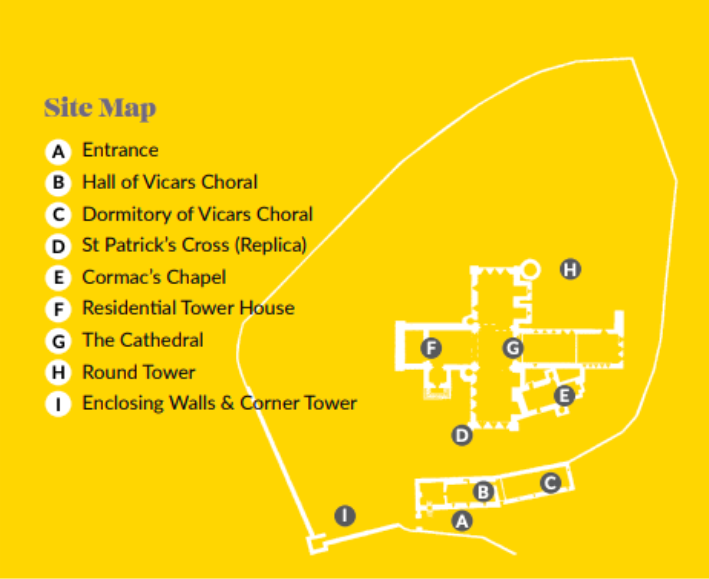
ST PATRICK’S CROSS: The entrance onto the Rock is dominated by a replica of a very large Celtic Cross. The Cross’s supporting arms can be seen, these would have supported its weight. The original cross stood atop a hollow stone base, which was believed to be Pre Christian. This original Cross and highlighted hollow stone base can be viewed in the small museum. Guided tours meet at St Patrick’s Cross.
The Rock of Cashel is made up of a number of buildings, these are as follows: The Round Tower, Cormac’s Chapel, The Cathedral, The Vicar’s Choir Hall and the Archbishops Palace.
THE ROUND TOWER: The tower dates back to the 12th Century and is the oldest surviving building on the Rock. The tower is called Cloigteach in Irish which means Bell House. The doorway is situated 13ft/3m above ground level possibly for reasons of defence or refuge. The tower originally had five timber floors, with trapdoors and ladders to allow progress through it. The interior today is hollow and the roof is still in good condition, which is rare in surviving Round Towers. The tower it is thought was also a place where items of value were stored. Around 80 round towers survive in various conditions around Ireland.
CORMAC’S CHAPEL: The Chapel is named after its patron, King Cormac MacCarthy of Desmond (South Munster). Construction began in 1127 and the Chapel was consecrated in 1134. The Chapel is one of the earliest Romanesque style churches in Ireland and though it is small in size, its style was pioneering in Ireland in terms of extensive use of carved ornament and decoration. The chapel’s style shows influences from England and the Continent, for example the use of side towers, blind arcading, carved ornament and frescos. The Chapel’s architecture was possibly influenced through trade and pilgrimage. The Chapel is unique in Ireland in that it has survived intact and it is constructed of (very soft) sandstone. The Chapel contains a sarcophagus attributed to King Cormac which is richly carved. The most beautiful aspects of the Chapel are the frescos which survive in a piecemeal state. The blue within the frescos comes from lapis lazuli, which came from modern day Afghanistan. Entrance by guided tour ONLY.
THE CATHEDRAL: The Cathedral was built between the 1230’s and 1270’s under three successive Archbishops and is Gothic in its style and is built as a traditional cruciform Cathedral, with a choir, chancel, nave and transepts which contain chapels. A south transept chapel is decorated with a newly discovered medieval fresco. In the 15th Century the Cathedral tower was extended and with the building of the Bishop’s Palace, the nave became truncated and seems rather small. The tomb burials in the Cathedral date from the 16th to the 20th centuries and one of those burials is Archbishop Miler McGrath who is buried in the south chancel wall. Miler McGrath was Archbishop from 1571 to 1622, he was both Catholic and Protestant during his lifetime of 100 years. The Cathedral’s roof was removed in 1749.
THE VICAR’S CHOIR HALL: The Hall of Vicars was built in the 1420’s for the resident Cathedral Choir, it was abandoned in the 18th century, as was the rest of the Rock and was restored to its present form in the 1970’s. The furnishings within what was the dining hall are meant to reflect the way it appeared when originally in use. The walls are lime washed, tapestries hang from the wall and the richly coloured paintwork on the timbers uses techniques from the period when the hall was at its height. The fireplace has a surviving Latin inscription which translates as ‘ES and EH had me made’.
ARCHBISHOPS PALACE: The Palace was constructed in the 15th Century in the style of a Tower House. The Palace is defensive in its design, with thick walls and narrow window openings. There are passages within the thick walls that allowed access from one part of the building to another. The Palace was the residence of the Archbishop until the 1700’s, when a new residence was built in Cashel Town. Much of the south wall of the Palace collapsed during a storm (tail end of a hurricane) in 1848, and a large piece of masonry now lies on the grass adjacent to the Palace.
The Rock of Cashel is one of the most historic, atmospheric and beautiful sights in Ireland and time could be allowed for group members to wander, explore and to soak up the magic of the Rock.